
For years, application development largely revolved around structured data and text-based interactions. Users entered information through forms, searched using keywords, uploaded documents, or communicated through text. Artificial intelligence expanded these capabilities with natural language processing, predictive analytics, and generative AI.
The next shift is broader: applications can increasingly understand and work with multiple types of information at the same time.
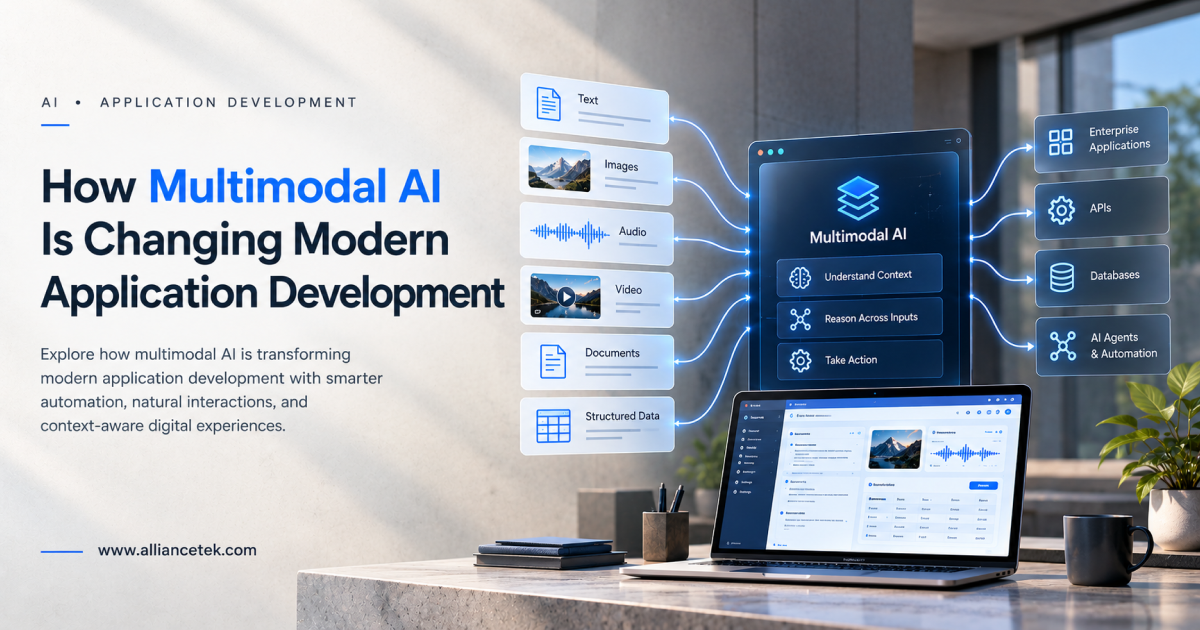
Multimodal AI enables applications to process and connect text, images, audio, video, documents, and other data types within a single workflow. This is changing what developers can build and how users interact with software. Current developer platforms increasingly provide APIs for vision, audio, documents, and other modalities, making multimodal capabilities more accessible for production applications.
For businesses, this creates opportunities to build applications that understand more context, automate complex processes, and provide more natural user experiences.
What Is Multimodal AI?
Multimodal AI refers to artificial intelligence systems that can process or generate information across multiple data modalities, such as:
- Text
- Images
- Audio
- Video
- Documents
- Speech
- Structured data
A traditional AI application might analyze a written customer request. A multimodal application could analyze the customer’s message, an attached image, a product document, and a voice recording as part of the same workflow.
This broader understanding allows applications to work with information in a way that more closely resembles how people interact with the real world.
Why Multimodal AI Matters for Application Development
Most business processes do not depend on a single type of data.
A healthcare organization may work with clinical notes, medical images, voice conversations, and documents. A financial organization may process forms, scanned documents, transaction information, and customer calls. A manufacturing company may need to analyze equipment images, sensor information, maintenance documents, and technician reports.
Multimodal AI allows developers to bring these different sources together.
Gartner has highlighted image and video integration as an important direction for AI applications because combining different data modalities can support more nuanced decision-making and improve AI agent accuracy.
1. Applications Can Understand More Than Text
One of the biggest changes is the ability to move beyond text-only application experiences.
For example, an insurance application could allow a customer to upload a photograph of vehicle damage and provide a description through voice. A multimodal AI system could analyze both inputs and help initiate the appropriate claims workflow.
Similarly, an e-commerce application could allow customers to upload a product image and ask a question about it using natural language.
Instead of forcing users to convert everything into text, applications can work with information in the format that is most convenient for the user.
2. User Experiences Will Become More Natural
Multimodal AI is also changing application interfaces.
Traditional applications require users to learn menus, forms, buttons, and navigation paths. AI-powered applications can increasingly allow users to communicate through a combination of text, speech, images, and other inputs.
For example, a field service application could allow a technician to photograph equipment, describe the issue verbally, and receive troubleshooting recommendations.
This creates a more flexible interaction model in which users are not limited to a single input method.
Modern multimodal AI platforms are increasingly designed to support these combinations through APIs and application-development frameworks.
3. Document Processing Will Become More Intelligent
Businesses process large volumes of documents every day, including invoices, contracts, applications, reports, forms, receipts, and statements.
Traditional document processing often depends on OCR, predefined templates, and rule-based extraction. Multimodal AI can provide a more contextual approach by interpreting text, document structure, tables, images, and other visual elements together.
For example, an intelligent finance application could:
- Receive an invoice.
- Identify vendor information.
- Understand line items and totals.
- Compare the invoice with purchase-order information.
- Detect inconsistencies.
- Route the document for approval.
This can reduce manual data entry and make document-heavy business processes more efficient.
4. AI-Powered Search Will Go Beyond Keywords
Search is another area that multimodal AI can significantly change.
Traditional search generally depends on text, metadata, and structured fields. Multimodal search can allow users to search across different types of information.
For example, a user could search for:
“Find the product demonstration video where the speaker discusses the installation issue.”
A multimodal system could use the text query to identify relevant content across video, audio, transcripts, images, and documents.
This approach can be particularly valuable for enterprises with large collections of unstructured information.
5. Multimodal AI Can Improve Business Automation
Multimodal AI can make automation more capable because workflows no longer need to depend entirely on structured inputs.
Consider a customer-support workflow. A customer could submit:
- A written complaint
- A screenshot
- A voice message
- A product video
A multimodal AI application could analyze these inputs together, identify the issue, retrieve relevant information, create a support case, and recommend the next action.
This moves application automation from simple rule-based processing toward more context-aware workflows.
6. Application Architecture Will Need to Evolve
Adding multimodal AI to an application is not simply a matter of connecting an AI API.
Developers need to consider how different data types move through the application and how AI-generated results are handled.
A modern multimodal application may include:
- User interface: Supports text, images, voice, video, or document uploads.
- AI orchestration layer: Determines which AI capabilities should process the input.
- Multimodal AI models: Analyze or generate information across different modalities.
- Application APIs: Connect AI capabilities with business systems.
- Data layer: Stores structured and unstructured information.
- Security layer: Controls access to sensitive information and AI capabilities.
- Monitoring and evaluation: Tracks performance, errors, latency, cost, and output quality.
This architecture becomes particularly important as multimodal applications move from prototypes into production environments.
7. Multimodal AI Will Create New Mobile and Web Experiences
Multimodal AI is not limited to enterprise back-office systems.
Mobile and web applications can use multimodal capabilities to create more interactive experiences.
Examples include:
- Visual product search
- Voice-enabled applications
- AI-powered education platforms
- Image-based healthcare assistance
- Intelligent travel applications
- Visual customer support
- AI-powered content creation
- Video analysis
- Voice-controlled business applications
These experiences allow users to interact with applications using combinations of input rather than relying exclusively on traditional forms and menus.
8. AI Agents and Multimodal AI Will Work Together
The combination of multimodal AI and AI agents could become particularly important.
An AI agent can reason about a task and take actions, while multimodal AI can help the agent understand information from different sources.
For example, a maintenance agent could receive a technician’s voice description, analyze an equipment image, review maintenance records, and recommend the next action.
This creates a workflow where the AI system can see, hear, understand, reason, and act.
As businesses move toward agentic applications, multimodal capabilities can provide agents with richer context. Current AI development trends are already moving toward applications that connect models with tools, APIs, and real-world workflows.
9. Multimodal AI Can Improve Accessibility
Multimodal applications can also make software more accessible.
Users may interact with an application through speech rather than typing, images rather than written descriptions, or audio rather than visual interfaces.
For example, an application could convert spoken instructions into actions, describe visual content, summarize documents, or provide information through voice.
This can help organizations design applications for a broader range of users while creating more flexible interaction models.
10. Developers Must Consider Performance, Cost, and Security
Although multimodal AI creates new possibilities, it also introduces development challenges.
Processing images, audio, and video can require more computational resources than processing short text prompts. Large files can increase latency and API costs, while sensitive information contained in images, documents, or recordings can create additional security and compliance requirements.
Developers should therefore consider:
- Data privacy
- Access controls
- Encryption
- Model accuracy
- API costs
- Processing latency
- File-size limitations
- Data retention
- Human oversight
- Monitoring and evaluation
Production applications should also test real-world inputs rather than relying only on ideal demonstration examples. Current developer guidance emphasizes evaluating modality-specific behavior, request handling, latency, and cost before selecting a multimodal approach.
11. Multimodal AI Will Change How Developers Design Applications
The impact of multimodal AI goes beyond adding another feature to an existing application.
Developers will increasingly need to ask:
- What types of information does the application need to understand?
- Which modalities are most useful to users?
- How should different inputs be combined?
- Which AI model or service should process each modality?
- What should happen when the AI is uncertain?
- Which actions require human approval?
- How should multimodal data be stored and secured?
This represents a shift from designing applications around screens and databases to designing applications around data, context, intelligence, and user intent.
Best Practices for Multimodal AI Application Development
Businesses planning a multimodal AI application development should start with a specific business problem rather than simply adding multiple AI capabilities.
A practical development approach includes:
Define the Business Use Case
Identify where images, audio, video, documents, or other data types can provide meaningful value.
Select the Right Modalities
Not every application needs text, image, audio, and video. Use only the modalities that improve the workflow or user experience.
Choose the Right AI Architecture
Determine whether the application needs a single multimodal model, multiple specialized models, or a combination of AI services.
Design for Security
Protect sensitive multimodal data with appropriate authentication, authorization, encryption, and retention policies.
Evaluate Real-World Performance
Test different file types, accents, image qualities, languages, background noise, and other conditions that users may introduce.
Monitor Production Behavior
Track accuracy, latency, cost, failures, and user feedback after deployment.
The Future of Multimodal AI Application Development
Multimodal AI is changing application development by allowing software to understand information in more of the formats people use every day.
The technology is moving beyond experimental demonstrations toward production-ready APIs and enterprise applications. Developers can now build experiences that combine text, images, audio, video, and documents within connected workflows.
The next stage will likely involve deeper integration between multimodal AI, AI agents, enterprise applications, and automation.
Instead of building software that simply responds to typed commands, businesses can create applications that understand richer context and help users complete complex tasks.
For organizations investing in AI application development, multimodal capabilities can become an important foundation for building more intelligent, accessible, and context-aware digital experiences.